
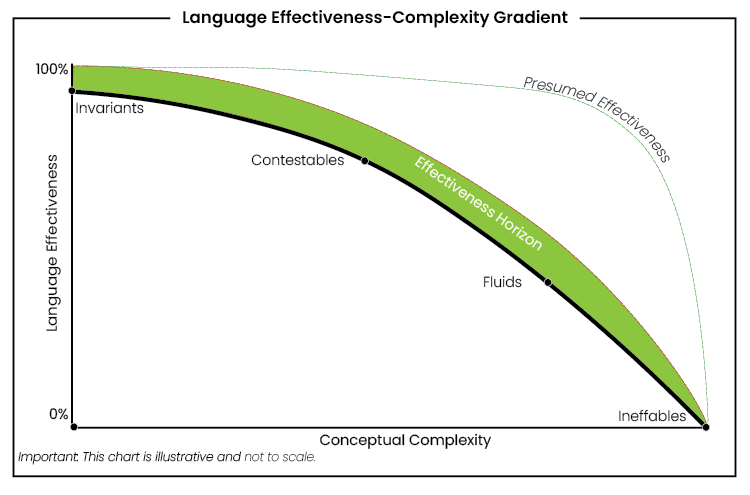
The Language Effectiveness–Complexity Gradient is a central piece of A Language Insufficiency Hypothesis published in 2025. Much of my subsequent works rests on these assumptions. I’ve made Chapter 3 available, which discusses this concept and its constituents. Download the PDF below.

The PDF, and of course the book, detail the chart embedded above.
3.1 Invariants
At the stable end of the Gradient lie Invariants. Here, language works well enough that disagreement is rare and usually pedantic. Nobody argues about whether a chair exists, whether water boils at 100°C at sea level, or whether two plus two equals four. These statements hold with pragmatic stability.
This does not mean they are metaphysically beyond dispute – philosophy professors have made a sport of denying chairs – but that in everyday practice, their meaning is fixed enough to guide action. When someone asks you to ‘bring the chair’, you don’t return with a sofa. Even if sofa and couch differ in nuance, their class membership remains stable: both are seats.
The strength of Invariants lies in categories and subclasses. A dog remains a dog whether it is a poodle, a greyhound, or a mutt. The category is secure, and disagreements about breed or naming don’t undermine the broader reference. These terms function as reliable coordinates: they anchor communication, allowing us to move through the world without constant clarification.
For the Language Insufficiency Hypothesis, invariants set the baseline. It is the zone where language approaches the effectiveness we think we have everywhere. But it is also the exception that proves the rule. The moment we step beyond physical objects, simple properties, or stable taxonomies, cracks appear. What looks like solidity at the left edge of the Gradient quickly erodes as we move rightward into Contestables.
3.2 Contestables
Step one notch rightward on the Gradient and stability begins to fracture. Contestables are concepts that societies cannot live without, yet cannot agree upon. Justice, fairness, freedom, rights, equality – these words anchor constitutions, inspire revolutions, and fill courtrooms. And yet each is perpetually fought over, their meanings split along political, cultural, and historical lines.
W. B. Gallie called these ‘essentially contested concepts’ (1956), and for good reason. The very attempt to define them invites conflict. To call a law ‘just’ or a policy ‘fair’ is to make a claim not only about the world but about how the world ought to be. Contestables carry normative weight. They are stakes in a struggle, not neutral descriptors.
NB: I disagree with Gallie’s treatment of essentially contested concepts. Where he suggests that these are semantically flexible so they might be defined later by context, I argue that this is not intentional, but rather inevitable by their nature.
Institutions try to stabilise them. Courts write judgments, parliaments pass statutes, agencies issue guidance – all in the name of fixing meaning. But the fix is temporary. ‘Reasonable’ in one case becomes ‘unreasonable’ in another; ‘freedom’ expands or contracts depending on who invokes it. Governments and judges pretend to pin these terms down, but in practice, they wield them as instruments of authority.
For the Language Insufficiency Hypothesis, Contestables illustrate why presumed effectiveness is a delusion. We speak as if justice has one meaning, but our interlocutor may be playing an entirely different game. Dialogue may find partial overlap, but consensus is fragile and reversible. These terms are not failures of precision that more time will resolve; they are battlegrounds structured for permanent dispute.
The most one can achieve with Contestables is not resolution but provisional coexistence. This is sometimes described as ‘agreeing to disagree’, but even that phrase misleads by implying a stable détente. In practice, such arrangements are unstable equilibria – disequilibrium states maintained by pragmatic compromise, institutional authority, or sheer fatigue. They persist only until the next confrontation reopens the fissure. The desire for closure is rational, but closure itself remains structurally unavailable.

3.3 Fluids
Beyond contestables lie the Fluid terms. These are concepts that do not just invite dispute but slip across contexts, disciplines, and times. They are amphibious, living in more than one environment without settling in any.
Wittgenstein’s lesson about ‘games’ is instructive here: no single feature unites them, only a tangle of family resemblances. Terms like intelligence, consciousness, or equity operate the same way. In neuroscience, consciousness may mean patterns of neural firing; in philosophy, it is qualia and subjectivity; in computer science, it is system responsiveness or adaptive behaviour. Each usage has legitimacy in its own context, but none rules them all.
Fluids are more than ‘contested’. They are mobile. A scientist and a policymaker may agree on the word intelligence but not on what it describes, and they may not even notice the gap until it widens into misunderstanding. In one domain, the term is technical, in another rhetorical, in a third metaphorical. Drift is not an accident here but the default.
For the Language Insufficiency Hypothesis, fluidity shows why repair attempts reach their limit. Clarification works within a single frame, but as soon as the conversation straddles domains, definitions multiply and overlap without convergence.
Unlike Contestables, where parties battle over a shared stake, Fluids dissolve the stakes altogether. The word itself refuses to stay put.
3.4 Ineffables
At the far end of the Gradient lie the Ineffables – the places where language collapses entirely. Here words strain, stumble, and finally fall silent. What remains are private sensations, raw qualia, mystical experiences, or metaphysical claims that resist capture.
The redness of red, the exact texture of pain, the interior hush of awe: these are all immediately felt but only clumsily described. We can gesture, compare, or approximate, but the words never quite reach. The more we try, the more inadequate they sound. Poets stretch metaphor to its breaking point, theologians invoke paradox, mystics retreat to silence.
Ineffables are not merely ‘difficult to define’. They are, by definition, beyond definition. Any attempt to pin them down produces vagueness or contradiction. To say ‘I am in love’ or ‘I felt the sublime’ communicates something, but not the thing itself. The listener recognises the sign but not the substance.
For the Language Insufficiency Hypothesis, the Ineffables are the terminus of collapse. They mark the point where effectiveness reaches zero. No matter how long we talk, no matter how many synonyms we pile up, the gap between expression and experience remains unbridgeable. If Invariants represent the closest we come to linguistic stability, Ineffables are the horizon beyond which words lose all traction.
Taken together, these categories trace a predictable decline in language’s effectiveness as conceptual complexity rises. Figure 3.1 visualises this Effectiveness–Complexity Gradient: a curve beginning in pragmatic stability, eroding through contestables and fluids, and collapsing at the ineffable.
This book does not claim to discover ambiguity. It reframes it. Gallie named ‘essentially contested concepts’; LIH shows where they sit on a continuous slope and why attempts at stabilisation hit a ceiling.
Quine raised indeterminacy; LIH distinguishes between dispute within a frame (Contestables) and drift across frames (Fluids), then ties both to a measurable presumption gap. Austin mapped how speech acts fail; LIH predicts failure rates rising with abstraction.
Grice and Lewis explained how cooperation and convention rescue local meaning; LIH explains why these rescues saturate as complexity rises.
Relevance theory shows how inference closes gaps when context is rich; LIH shows where context thins and inference becomes noise. In short: the pieces are known; the Gradient integrates them, adds the presumption gap and the effectiveness horizon, and shows why ‘more words’ or ‘better norms’ eventually stop paying.
The Gradient shows why language feels stable at one end (Invariants) but collapses into silence at the other (Ineffables), with presumed effectiveness and the effectiveness horizon marking where our confidence diverges most from reality.
As always, feel free to leave comments.