Chess with Heidegger
On Heidegger, and the rook that was always, secretly, a bishop


Imagine, if you will, that you are playing chess with a grandmaster. Your opponent fingers his rook, slides it diagonally across the board, captures your queen and lifts the piece away. Nonplussed, you question the tactic. He defends it with vehemence.
Download a PDF with image assets related to this topic.

“The rook has always essentially wanted to move diagonally,
but ordinary chess has concealed this primordial rookhood.”
‘This is what you must understand’, he says. ‘The rook has always essentially wanted to move diagonally, but ordinary chess has concealed this primordial rookhood. I have done nothing but liberate my rook, as all rooks ought to be liberated’.

You counter, reasonably enough: ‘The diagonal is reserved for bishops – and the queen, and the king, and in their small way the pawns – but never the rook.’
He’s not finished. ‘You speak of bishops. But the bishop’s diagonal is fallen, uneigentlich, inauthentic – a diagonal lived in the mode of das Man, the anonymous ‘one’ who moves only as one moves. My rook does not move diagonally in that degraded sense. It frees itself toward its ownmost diagonal possibility. The rook, you see, is the one piece for whom its own being is in question. What you call a capture is its resolute Sein-zum-Tode – though here, of course, the death is your queen’s’.
You try once more. Surely the rules—
‘The rules’, he says, gently, ‘are precisely the Seinsvergessenheit, the forgetting, from which the rook must be recalled. You object in the only vocabulary the board has left you, and that vocabulary is the concealment I have overcome. Clarify your language. Strip away the sediment. Then – only then – will you grant that my move was always valid’.
And there is the trap, sprung so softly you may not feel the teeth. You came armed with the rules; he has reclassified the rules as the disease, and so your every objection now arrives pre-translated into his idiom, where it reads as assent. To dispute him, you must speak his language, and his language has already granted the move.
This, more or less, is what Heidegger does in Sein und Zeit, and again in the lecture Vom Wesen der Wahrheit. Wittgenstein turns in his grave; Martin is unfazed. He runs the same play on freedom, on truth, on being, and – with an entirely straight face – on nothing. (Das Nichts nichtet: the nothing noths. One is not invited to laugh.)
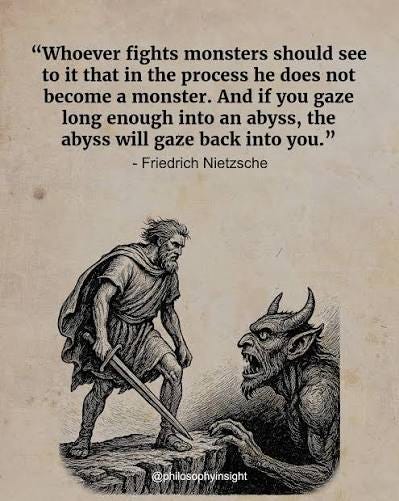
Reading Heidegger has a reputation for being difficult and profound. It may be, but the profundity diminishes once you catch his move. He takes ordinary language, strips away any polysemy or other ambiguity, and offers his definition. He is not simply declaring his preference; he changes the field and insists his rook may move on the diagonal. Moreover, he says this is how it always should have been. The Académie would be proud. You stare into space and contemplate the void – or perhaps this is Nietzsche’s abyss. You wonder if it matters and if you’ve missed anything.
Whilst Heidegger’s work has this reputation for difficulty and depth, the reputation is not wholly undeserved. But a good portion of the profundity drains away the moment you catch the move. He takes an ordinary word, planes off its polysemy and its ambiguity, fits it with a definition of his own – and then, crucially, announces that this is what the word always already meant, that the tradition merely forgot, that he is recovering rather than coining. He is not changing the field. He would never change the field. He is dusting a field that was, he assures you, always shaped exactly so.
Now, the honest objection – and I would rather meet it than dodge it – is that chess is the wrong analogy, because chess has no essence to recover. Its rules are conventions, nakedly so; nobody has forgotten the buried rookhood, because there is none to forget. Heidegger’s whole wager is the inverse: that language does carry a sedimented meaning, an aletheia, an un-concealment the tradition fell away from, and that he retrieves what was lost. The grandmaster decrees; Heidegger, his defenders insist, argues – from the structure of being-in-the-world, from the manner in which Dasein discloses its world before it ever forms a proposition about it. Sure. And it changes nothing.
The charge was never that recovering a buried grammar is illegitimate. Words do carry structure we never chose; that much I will concede without resistance, having staked rather a lot on it elsewhere. The charge is narrower – and it’s worse. It’s that recovery-rhetoric – this is how it always was, the tradition merely forgot – is constructed so that nothing could ever count against it, which makes it function as decree whilst only wearing a disguise, the costume of description. Exposure shows you the rule that was there all along, whilst legislation writes a new rule and backdates the receipt. Heidegger’s legerdemain performs the second whilst narrating the first. The grandmaster doesn’t uncover some hidden permission for his rook; he issues one, and then relics it, a bit of patina for good measure.
So no – the Académie wouldn’t be proud after all. At least the Académie has the decency to admit that it’s legislating. What Heidegger shares with it is only the pose: the serene magisterial conviction that one man may stand as custodian of what the words really mean. The difference is that the Académie nails its prescriptions to the door like Luther, but Heidegger smuggles his in under a flag of recovery and dares you to salute it.
In the end, you sit back. The rook hasn’t moved. It rests defiantly on its diagonal square, your defeated queen beside it in the box; the grandmaster waits with the easy patience of a man who knows the position is won. And the worm turns over in you – the small, disreputable suspicion that the philistine in this room might be you; that perhaps he has seen something, and you have merely failed to clarify your language. You reach for the rule book. You find it has been rewritten. It is, you are assured, how it always read.
This content was produced by Bry Willis, a philosopher with a focus on language. He shares content here on Substack as well as on his Philosophics Blog. Bry uses various LLMs in his production workflow at all stages, from ideation to production, as well as for the production of ancillary content – audio and video summaries, images, PDFs, and possibly other media.
You can also find him on various social media platforms:
For more information, check out his About Me page