

We all remember Hobbes. Not Calvin’s pet tiger, regrettably, but the Leviathan one: the cheerful fellow who looked at human beings and concluded that, left to themselves, they would make life ‘solitary, poor, nasty, brutish, and short’. A line so good it almost excuses the anthropology. Almost.
Download a PDF with image assets related to this topic.

Hobbes begins from fear. Not a trivial fear, either. Not the scented-candle anxiety of modern self-help, but the older, uglier fear of exposure: the fear that another person may injure, rob, dominate, humiliate, or kill you, and that no higher authority will arrive to stop them. In that condition, he says, human life collapses into insecurity. Every person becomes a possible threat. Every neighbour becomes a calculation. Every peace is temporary because no one can enforce it. So far, Hobbes is not wrong.
The human being is vulnerable. The solitary individual is exposed. Small groups may cohere, but coherence does not defend itself by being charming. The family can be threatened by another family; the village by another village; the tribe by another tribe. At some point, human beings discover that kindness, kinship, and local trust do not stop the larger, hungrier formation from arriving with weapons, flags, creditors, theology, or all four at once.
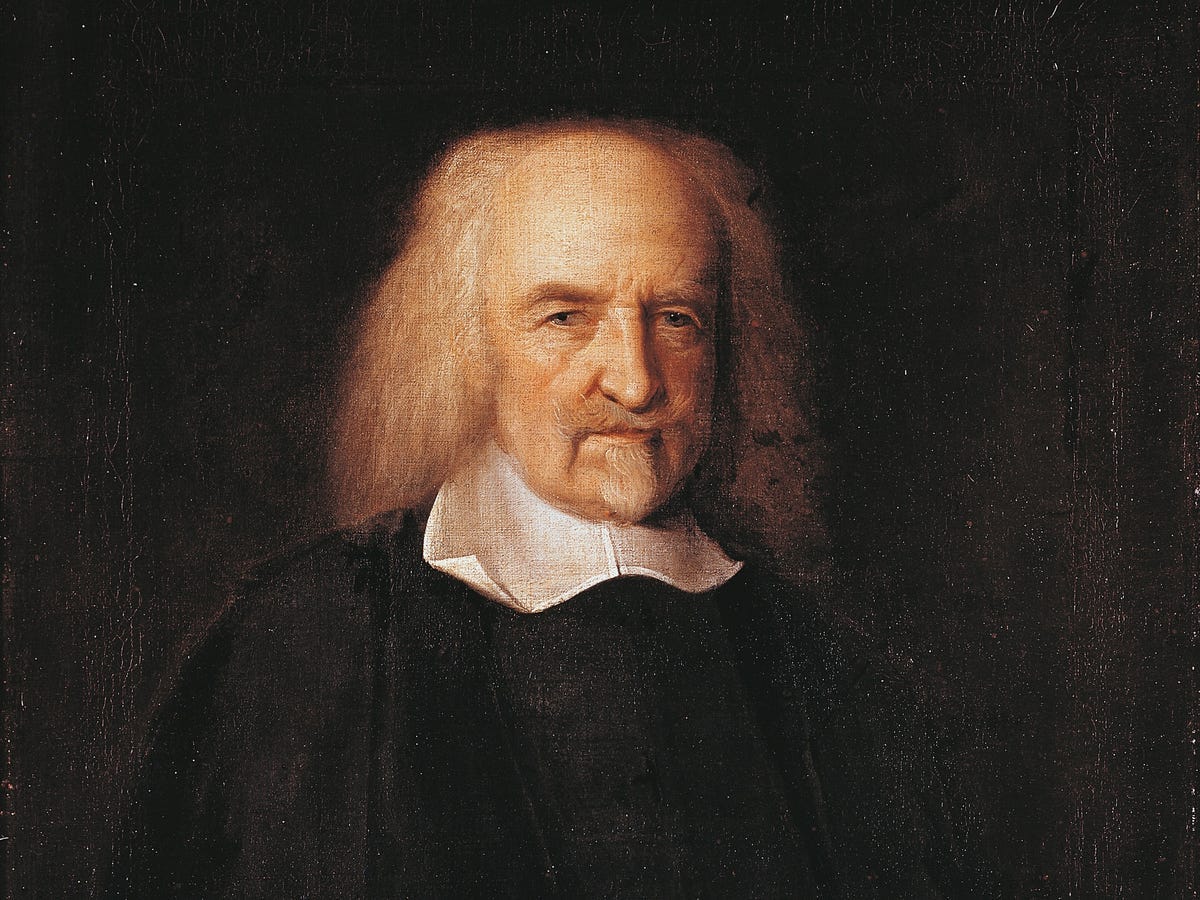
Hobbes’s answer is sovereignty. The social contract gathers scattered individuals into a single artificial body. We surrender some freedom so that we may stop sleeping with one eye open and one hand near the nearest blunt object. The sovereign stands above the quarrels of individuals and monopolises force. Step out of line, and the punishment is no longer personal revenge but public authority. Easy peasy. Piece of cake.
Hobbes favours monarchy because monarchy gives the problem a face. One sovereign. One will. One bloke at the top of the heap, preferably with enough theatrical menace to keep the rest of us from turning political life into a knife drawer. The appeal is obvious. Disorder is plural; sovereignty is singular. Many wills produce chaos; one will produces order. Or so the story goes. But this is where Hobbes becomes short-sighted.
He saves individuals from the state of nature by collecting them into a larger unit. That larger unit does not leave nature behind. It merely re-enters it at scale. The person becomes the subject; the subject becomes the kingdom; the kingdom becomes the combatant. What was once person against person becomes kingdom against kingdom.

The state of nature hasn’t disappeared. It’s merely changed costumes. In fact, we fight it today. The evolution might have looked like this:
Person against person.
Family against family.
Village against village.
Tribe against tribe.
State against state.
Nation against nation.
Empire against empire.
Planet against planet, if we are going full Star Wars, for which I ask forgiveness from Captain Kirk. The point isn’t the science fiction. Rather, it’s recursion.
I’m giving it all I’ve got, Captain. She can’t take any more. But she always does.
Hobbes thinks sovereignty solves exposure. It doesn’t. It relocates exposure upward. Inside the state, the sovereign may pacify private violence. But outside the state, sovereigns confront one another without a sovereign above them. They become enlarged individuals, each suspicious, armed, proud, frightened, and ready to call aggression defence because political language exists largely to launder appetite into necessity.

This is the Hobbesian remainder. The Leviathan pacifies internally by becoming externally dangerous. The state protects its subjects by concentrating their violence into itself, then turns outward into a world of other concentrated violences. Monarchy doesn’t abolish the wolf. It crowns him, gives him a border and a revenue office.
The arrangement only works as a universalist dream. One sovereign over all. One world-state. One final authority powerful enough to end the competition between authorities. But this dream immediately produces its own horror. A universal sovereign might end interstate anarchy only by creating a scale problem so vast that exit, dissent, and local intelligibility become nearly impossible. The local tyrant can be fled. The universal one becomes a single climate.
Federations try to soften the problem. They divide sovereignty, layer authority, distribute competence, and pretend that the resulting contraption is not a theological puzzle wearing an administrative lanyard. Sometimes this even works well enough – for a time. Local units preserve some human-scale governance; larger units provide defence, coordination, and infrastructure. But federations don’t abolish the problem either. They introduce new sites of conflict: centre against periphery, local legitimacy against central authority, regional identity against national abstraction, and administrative coherence against lived plurality. The scale problem remains intact.
Small groups are more intelligible but less defensible.
Large groups are more defensible but less intelligible.
Small groups are more intelligible but less defensible. Large groups are more defensible but less intelligible. Sovereignty protects by abstracting; abstraction protects by flattening; flattening produces new forms of domination. The village knows your name but can’t stop the empire. The empire can stop another empire, but no longer knows what a person is, except as a census entry, tax unit, soldier, voter, patient, suspect, or statistical inconvenience. You’re just a number, mate.
This is why Hobbes was right, but only to a point. He understood that fear drives aggregation, that exposure is politically generative, and that order doesn’t emerge from goodwill alone – because goodwill is a lovely thing to have right up until the raiders arrive.
The problem is that he mistook aggregation for escape. He imagined that the state could rescue us from nature, when it more often reorganises nature into institutional form. Violence becomes lawful and monopolised.
Appetite becomes interest.
Fear becomes security policy.
Domination becomes governance.
I’m getting Orwellian vibes here.
![War is peace. Freedom is slavery." -- George Orwell [4032 × 2268] : r/QuotesPorn](https://substackcdn.com/image/fetch/$s_!qtCC!,f_auto,q_auto:good,fl_progressive:steep/https%3A%2F%2Fsubstack-post-media.s3.amazonaws.com%2Fpublic%2Fimages%2F3c9a0d8b-049a-46a5-a74d-d09139b5560c_1080x607.jpeg "War is peace. Freedom is slavery.\" -- George Orwell [4032 × 2268] : r/QuotesPorn")
Hobbes may have noticed the wolf at the door, but his solution was to let him in and construct a larger, more ferocious wolf indoors, but with the manners of diplomacy.