
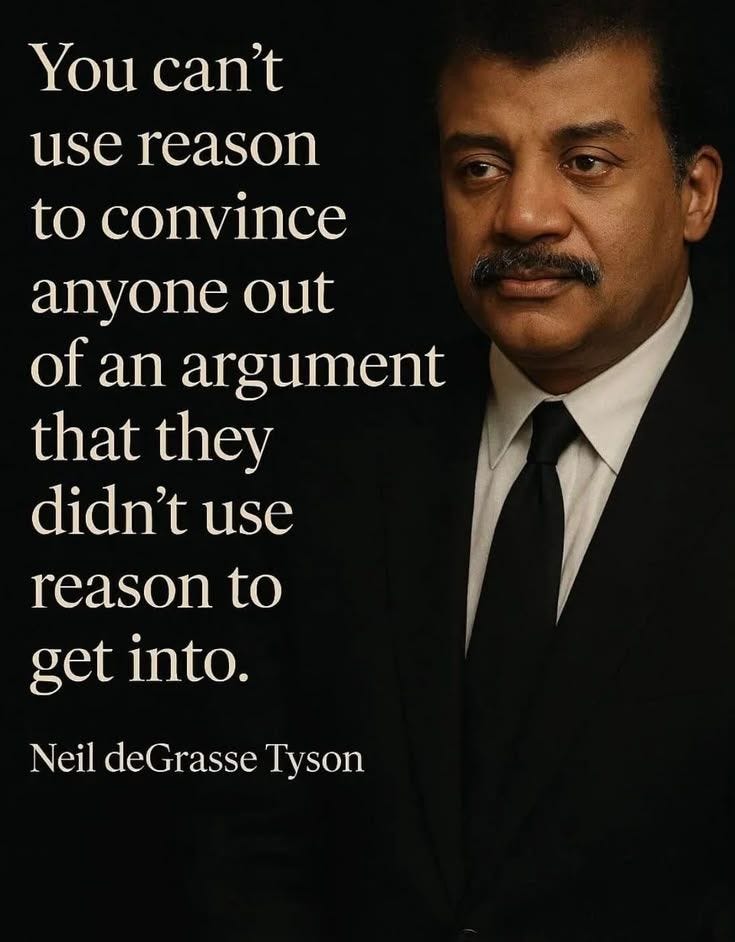
A quotation sometimes misattributed to Neil deGrasse Tyson1 declares:
You can’t use reason to convince anyone out of an argument that they didn’t use reason to get into.
The underlying thought is older. Jonathan Swift wrote in 1721 that ‘reasoning will never make a man correct an ill opinion, which by reasoning he never acquired’.2 The maxim survives because it captures something recognisable: beliefs rooted in custom, emotion, identity, or fear seldom collapse when presented with a tidier syllogism. But the problem may run deeper than irrational belief.
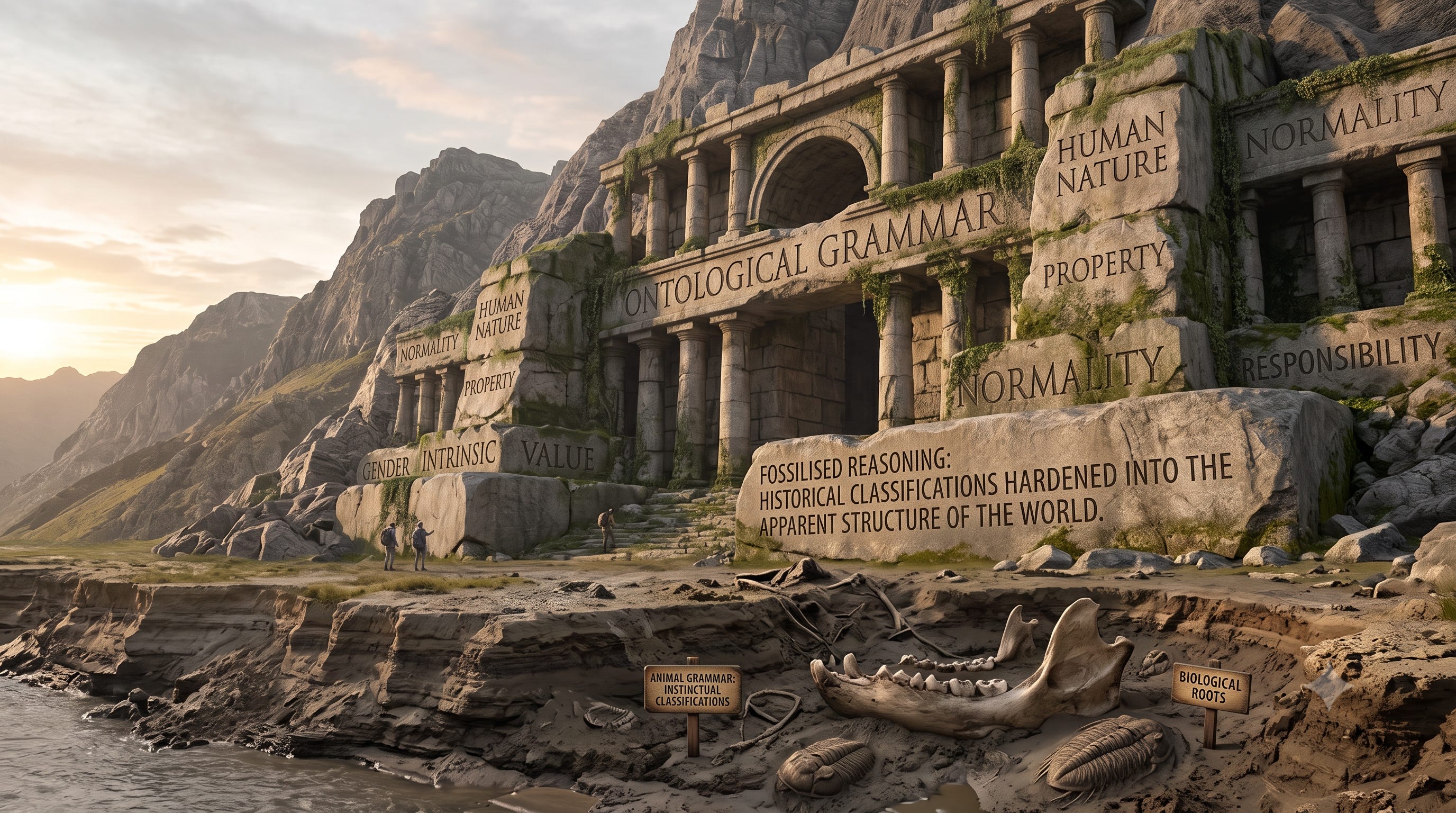
Ontological grammar is fossilised reasoning: historical classifications hardened into the apparent structure of the world.
Some convictions are not merely acquired without reasoning. They were acquired before the person could recognise them as convictions at all. They arrived embedded in language, institutions, habits, classifications, and ordinary descriptions of the world. They became part of what I call ontological grammar: the inherited conceptual structure that determines what kinds of things appear to exist, which distinctions seem natural, and which questions can sensibly be asked.
My social media colleague, meika loofs samorzewski, might recognise it as animal grammar, but I am not intimate enough with this concept to make a definitive argument about it. As I understand it, the relationship is shaped something like this:
Animal grammar explains how ontological grammar becomes possible.
::
Ontological grammar explains how animal discriminations become culturally fossilised, recursively elaborated and mistaken for reality.
I’d be interested in a more concise definition of animal grammar because I am working with a likely imperfect distillation of what I have gathered from internet publications.
Reason may have participated in the historical formation of these structures. Categories such as human nature, property, gender, intrinsic value, normality, and responsibility did not materialise untouched by argument. They have histories. They were assembled, contested, revised, and imposed.
Yet once established, their histories disappear from ordinary use. Yesterday’s conclusion becomes today’s premise. Eventually, it ceases even to appear as a premise and presents itself as an obvious feature of reality. When the scaffolding is removed, the building begins to look like geology.
This is why rational argument so often fails to reach the foundations of a dispute. Reason operates within the inherited grammar, testing propositions for consistency whilst leaving the conditions that make those propositions intelligible largely untouched. Someone may reason impeccably about whether human life possesses intrinsic value without noticing that human, life, possession, intrinsic, and value have already smuggled an ontology into the discussion.
So, the difficulty isn’t so much that reason can’t remove what reason didn’t install. It’s that reason may no longer recognise the installation because it’s miles above it.
To put a finer point on it – or to flog a dead horse –ontological grammar is fossilised reasoning: historical classifications hardened into the apparent structure of the world. Criticising it requires more than producing a stronger argument within its terms. It requires making the terms themselves strange again. Only then does what looked like reality begin to disclose itself as construction.
This content was produced by Bry Willis, a philosopher with a focus on language. He shares content here on Substack as well as on his Philosophics Blog. Bry potentially uses various LLMs in his production workflow at all stages, from ideation to production, as well as for the production of ancillary content – audio and video summaries, images, PDFs, and possibly other media.
You can also find him on various social media platforms:
For more information, check out my About Me page
I wrote this piece after seeing this meme on LinkedIn.
Jonathan Swift, A Letter To A Young Gentleman, Lately Enter’d Into Holy Orders.
a description of animal grammar realises that to understand the taphonomy of worlding one might/should understand how 'fossilisation' begins before death, or rather, more specifically, the body at death is already a record of life which then death finalises. The bones, the skeleton, are a record of animal movements in life's growth: 'fossilising itself' = growing. The deposition of the bones in a fossilising medium is step 2. As animals we then focus on what we find in the record, osteologists don't forget the life recorded at death.
An ontological grammar as a subset of animal grammar, is then analogous to the bones of that snapshot. Life is a self-fossilising process, survival maintains the forms and attitudes. So an 'ontological grammar' thus described above by Bry, can be seen as a semi-intentional semi-unconscious stance arising out of worlding practicalities, dogmatism need not always be the outcome, but traditionally, it often is. The proportions of these ratios (worlding-the-self: animal grammar::ontological grammar) is what a comparative anthropology or primatology would look at. A "geography" of a taphonomy of worlding [study proportions of worlding::selfing] in which the taphonomy of worlding is a key early "step" forward out of the mists of time (again) into a reflective modernity. (This is basically comparitive philology where we have linguistic records at one stage).
Much of this has been said before in the unrecorded axial age conversations that informed Buddhism, Taoism and Pyrrho of Elis., of which we do have the bones. None of them wrote stuff down. All we have is our revered bones.
https://whyweshould.loofs-samorzewski.com/taphonomy-of-worlding/
has link backs to substack crossposts in articles, mostly,
older writing on proportion
https://whyweshould.substack.com/p/proportions-of-the-janus-ratio