
I’m such a liar. I can’t even trust myself.
Today, we’re going to work on editing the manuscript.
Just a quick peek at the social media. Just a sec, right?
A civilised interval, a tiny procedural detour. Merely a harmless glance into the infinite slot-machine of other people’s opinions. What could possibly go wrong, apart from the rest of the morning, right?

Responding to a post, I found myself returning to that iconic, routinely misrepresented scene from The Matrix: the one with the spoon. The scene has been dragged through so many motivational seminars, self-help swamp rituals, pseudo-Buddhist wall decals, and entrepreneurial cocaine-affirmation threads that it now arrives pre-misunderstood.
Even Baudrillard distanced his work from the version of simulation the Wachowskis made cinematic. This is not a criticism, exactly. Film has two hours to smuggle metaphysics through leather coats, sunglasses, and slow-motion firearms. One makes allowances. Philosophy, alas, has fewer trench coats and more footnotes.
There are only structured constraints, mediational architectures, coherence zones, and the recurring human error of mistaking nouns for ontology.
The exchange is familiar enough. If you don’t know the scene, here are some reminders or at least context.
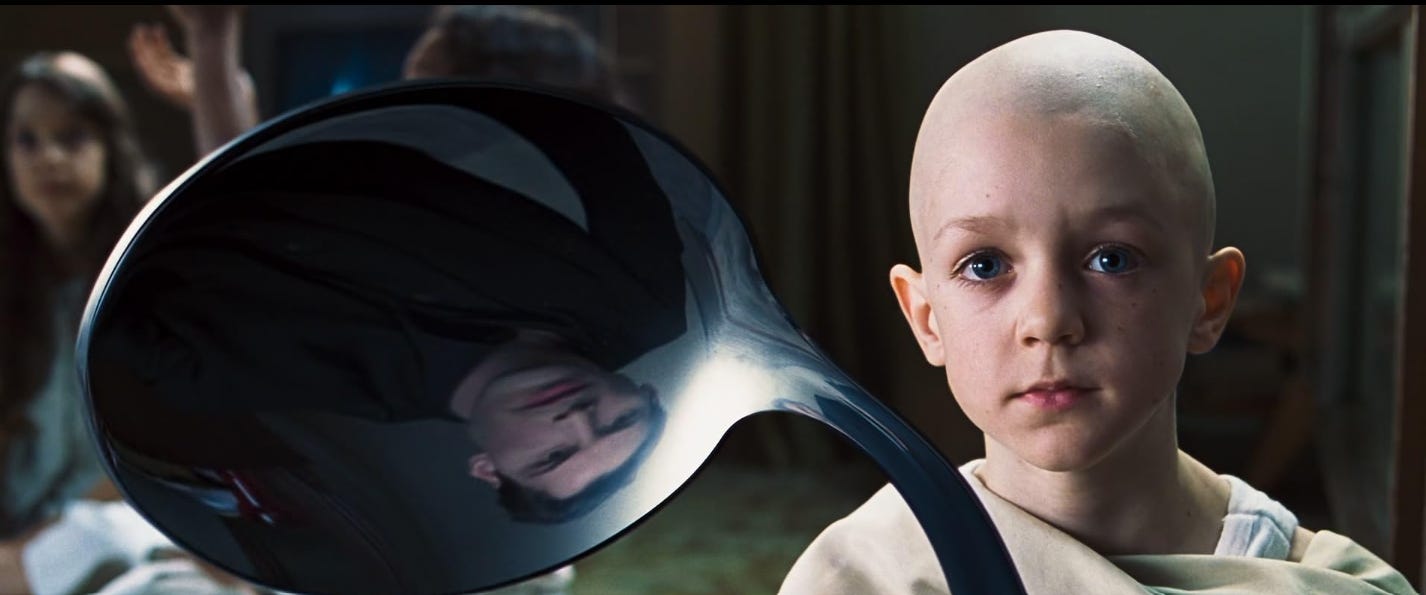
In the scene, the boy tells the protagonist, Neo, that he can’t.
Spoon boy: Do not try and bend the spoon. That’s impossible. Instead only try to realise the truth.
Neo: What truth?
Spoon boy: There is no spoon.
Neo: There is no spoon?
Spoon boy: Then you’ll see that it is not the spoon that bends, it is only yourself.
The popular reading is usually some dreary little anthem of self-mastery: reality is fake, therefore believe harder. Bend the spoon. Manifest the parking space. Bootstrap your chakras. Become the CEO of Quantum Delusion™ by Tuesday.
But there’s something more interesting happening here, whether or not the scene intended it.
Allow me, because apparently this is now my burden, to explain it through MEOW: the Mediated Encounter Ontology, developed further in The Architecture of Encounter.
Under MEOW, there are no objects and subjects in the foundational sense. There are structured encounter-events. ‘Object’ and ‘subject’ are scale-dependent compressions, useful enough for ordinary traffic, shopping lists, surgery, and blaming the cat, but not metaphysical bedrock. The spoon isn’t an ontological spoon. It’s a stabilised encounter-profile, a persistent pattern of constraint across mediated engagements.
And you?
Sorry, mate. Bad news.
There’s no you either. Johnny, we hardly knew ye…
Not in the thick, sovereign, self-owning, internally lit, Cartesian executive-suite sense in which Modern™ people have been trained to imagine themselves. There’s no little monarch inside your skull, issuing decrees to the limbs and personality traits.
‘But I’m here’, you protest in vain.
Yes. Congratulations. Something is happening.

The point is not that you’re a hologram, a simulation, a hallucination, or an underfunded NPC in God’s failed graduate project. Perish the thought. The relata and energetic patterns that configure this thing called ‘you’ are present. They persist. They resist. They answer back under constraint. Let’s call that real, because I’m not in the mood to cosplay Heidegger merely to avoid a serviceable word.
But ‘real’ doesn’t mean ‘substance’, ‘self-identical metaphysical nugget’, or that the noun has successfully captured the structure.
‘You’ aren’t a thing that has encounters. ‘You’ are a recurring stabilisation within an encounter.
Likewise, the spoon is not a thing hiding beneath appearances, waiting for consciousness to become sufficiently smug to bend it. Rather, the spoon is a coherence zone: tactile, visual, functional, linguistic, cultural, and practical. It holds together because constraints converge. It can stir tea or reflect light. It resists the hand but can be bent by pressure, heat, leverage, or cinema – obviously. It enters language as spoon because our grammar prefers little noun-shaped parcels.
So when the child says, ‘There is no spoon’, the useful reading is not that matter is imaginary. Rather, it’s that spoonness is not fundamental.
Spoonness is an achieved stability within mediated encounter. It’s what appears when a certain configuration of constraint, affordance, perception, language, and use becomes regular enough to be treated as a thing. Rather than being denied, the spoon is demoted.
Perhaps this is where The Matrix accidentally becomes more interesting than its own mythology. The real trick isn’t escaping illusion into Reality™. This is still Platonism, my arch nemesis. The trick is noticing that what we call reality is already organised through mediation, and that this doesn’t make it fake; it makes it encounterable.
So, there is no raw spoon behind spoon-experience as there is no raw self behind self-experience. There’s no view from nowhere outside the machinery where the final fixtures of the universe sit neatly labelled, waiting for philosophy to arrive for inventory. There are only structured constraints, mediational architectures, coherence zones, and the recurring human error of mistaking nouns for ontology.
This is the no-spoonness MEOW wants to take seriously.
Not:
‘nothing exists’
‘everything is simulation’
‘believe hard enough and physics will bend to your will’
Rather:
The things we treat as basic are often stabilised compressions. They work because they work, until we promote them into foundations and then act surprised when the metaphysics catches fire.
The spoon doesn’t vanish. Neither does the Self™.
And so you are, but you’re real only per se, but you’re not a holograph simulation either.
The relata and ‘energy’ that configure you are there, present; let’s call this ‘real’ because I don’t feel like coining another term and am not in the mood to cosplay Heidegger at the moment.
Don’t I have somewhere to be?
* Errata: I misremembered The Matrix as being released in 1997, so some of the ancillary material retains this bad reference.
This content was produced by Bry Willis, a philosopher with a focus on language. He shares content here on Substack as well as on his Philosophics Blog. Bry uses various LLMs in his production workflow at all stages, from ideation to production, as well as for the production of ancillary content – audio and video summaries, images, PDFs, and possibly other media.
You can also find him on various social media platforms:
For more information, check out my About Me page